Choosing the right metal roofing profile is an important decision for roofing material importers, steel distributors, construction contractors, and project procurement managers. Among the many options available from Chinese roofing sheet manufacturers, T-Type roofing sheets and IBR roofing sheets are two profiles that buyers may encounter when sourcing steel roofing materials for industrial buildings, warehouses, agricultural facilities, commercial properties, and residential construction.
Although both products are commonly manufactured from galvanized steel, galvalume steel, or pre-painted steel coils, their exact profile dimensions, rib geometry, effective coverage width, and intended applications may differ by manufacturer and market. These differences influence structural performance, water drainage, installation efficiency, material consumption, and total project cost.
For international buyers, the most important question is not simply which profile is stronger or cheaper. It is which roofing sheet offers the right combination of performance, compatibility, durability, and commercial value for a specific project.
As a professional Chinese building materials supplier, RoofGlory provides roofing and steel building material solutions for international importers, wholesalers, contractors, and construction projects. This guide compares T-Type roofing sheets and IBR roofing sheets to help buyers evaluate their specifications, identify the differences that matter, and make more informed purchasing decisions.
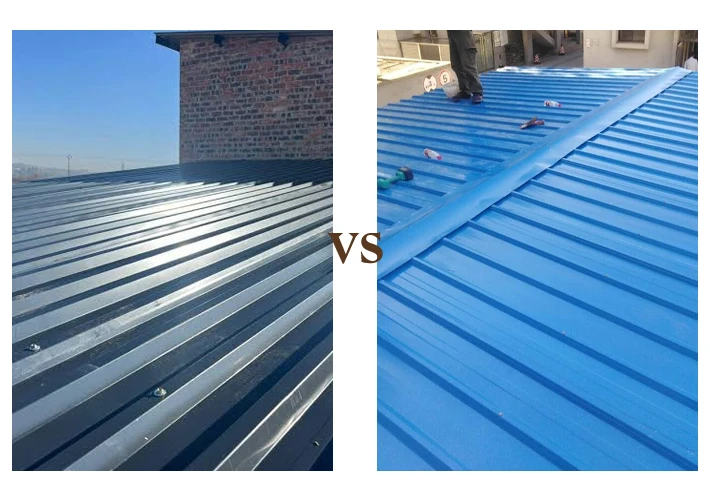
What Are T-Type Roofing Sheets and IBR Roofing Sheets?
Before comparing the two products, buyers should understand their basic structures and recognize that product names are not always standardized across international markets.
What Is a T-Type Roofing Sheet?
T-Type roofing sheet is a term used by some suppliers and buyers to describe a trapezoidal or ribbed metal roofing profile. Depending on the manufacturer and local market, the term may refer to a particular T-shaped profile design, a trapezoidal roofing sheet series, or a profile sold under a local commercial designation.
These sheets generally feature raised longitudinal ribs separated by relatively flat or recessed sections. The raised ribs increase the profile’s stiffness, while the lower channels help direct rainwater toward the eaves and drainage system.
T-Type roofing sheets are commonly produced through a cold roll-forming process. Flat steel coils are fed through a series of forming rollers that gradually shape the metal into the required profile. This process creates consistent ribs and allows manufacturers to produce roofing sheets in customized lengths.
Depending on the supplier’s production equipment and product range, T-Type sheets may be available in galvanized steel, galvalume steel, pre-painted galvanized steel, or pre-painted galvalume steel.
Common applications include:
- Industrial workshops and manufacturing facilities.
- Warehouses and logistics buildings.
- Commercial buildings and retail facilities.
- Agricultural sheds and storage buildings.
- Prefabricated steel buildings.
- Roofing and wall cladding systems.
The exact applications depend on the profile dimensions, steel grade, sheet thickness, coating specification, structural design, and local building requirements.
For buyers sourcing T-Type roofing sheets from China, requesting a technical drawing is particularly important. The product name alone does not establish rib height, effective width, sheet thickness, or allowable support spacing.
What Is an IBR Roofing Sheet?
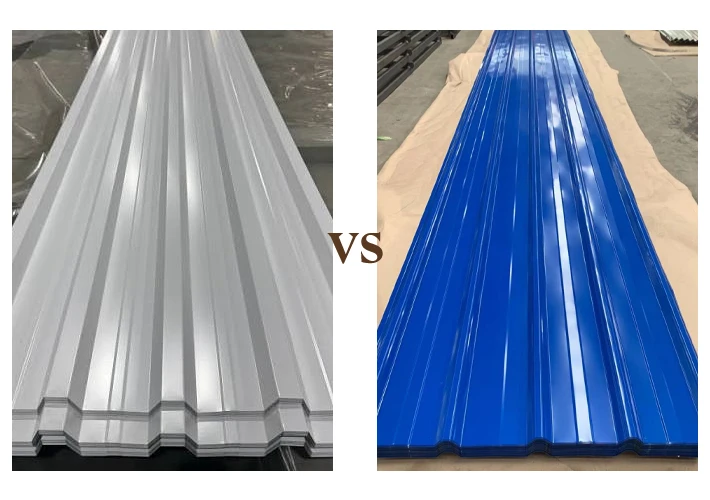
IBR stands for Inverted Box Rib. It is a recognizable metal roofing profile characterized by angular, box-shaped ribs and recessed channels.
Compared with conventional sinusoidal corrugated sheets, IBR roofing sheets have a more geometric appearance. Their rib arrangement is designed to provide profile stiffness while creating channels that guide rainwater down the roof.
IBR sheets are widely used in commercial, industrial, agricultural, and residential construction. They are particularly popular in markets where trapezoidal metal roofing is a familiar choice for warehouses, factories, workshops, and steel-framed buildings.
IBR roofing sheets can be manufactured from several steel substrates, including:
- GI steel: Galvanized steel with a protective zinc coating.
- GL steel: Galvalume or zinc-aluminum-coated steel.
- PPGI steel: Pre-painted galvanized steel.
- PPGL steel: Pre-painted galvalume steel.
The appropriate substrate depends on the intended service environment, required corrosion resistance, appearance, budget, and project specification.
IBR sheets are available in different thicknesses, rib configurations, effective coverage widths, and lengths. Actual dimensions vary by manufacturer and regional profile standard.
For example, RoofGlory’s existing IBR product information discusses galvanized, galvalume, and color-coated options for industrial and commercial applications. Buyers can use the manufacturer’s technical information as a starting point when preparing a project specification. Product-specific dimensions and coating requirements should be confirmed before ordering.
Why Do Buyers Compare T-Type and IBR Roofing Sheets?
The two products may appear similar because both can feature trapezoidal ribs and longitudinal drainage channels. In some markets, their commercial names may even overlap.
However, similar appearances do not necessarily mean identical profiles.
The actual differences may involve rib height, rib spacing, trough width, side-lap geometry, effective coverage width, and compatibility with existing roofing systems.
These details matter because roofing performance is determined by the complete profile and installation system rather than the product name alone.
Buyers should therefore request a cross-sectional drawing, dimensioned specification sheet, and sample whenever the distinction between T-Type and IBR is important to the project.
If two suppliers use different names for geometrically similar profiles, comparing their actual drawings is more reliable than comparing their product titles.
T-Type Roofing Sheet vs IBR Roofing Sheet: Key Differences
The most useful comparison for buyers focuses on measurable product characteristics rather than broad marketing claims.
The following table summarizes the main purchasing considerations.
| Comparison factor | T-Type roofing sheet | IBR roofing sheet |
|---|---|---|
| Profile shape | Generally trapezoidal or ribbed, depending on the supplier’s definition | Characteristic angular, box-shaped inverted ribs |
| Rib geometry | Varies by T-Type design and manufacturer | Defined by the particular IBR profile specification |
| Structural stiffness | Depends on rib depth, steel thickness, steel grade, and profile geometry | Depends on rib depth, steel thickness, steel grade, and profile geometry |
| Water drainage | Longitudinal channels direct water toward the roof edge | Longitudinal channels direct water toward the roof edge |
| Effective width | Profile-specific | Profile-specific |
| Sheet thickness | Must be confirmed with the manufacturer | Must be confirmed with the manufacturer |
| Material options | GI, GL, PPGI, PPGL, subject to supplier capability | GI, GL, PPGI, PPGL, subject to supplier capability |
| Installation | Requires compatible laps, fasteners, and support spacing | Requires compatible laps, fasteners, and support spacing |
| Appearance | Depends on the specific T-Type profile | Usually features a distinctive angular rib pattern |
| Replacement compatibility | Must match the existing profile and fixing arrangement | Must match the existing IBR profile and fixing arrangement |
| Best purchasing approach | Verify the exact profile drawing and project requirements | Verify the exact IBR specification and project requirements |
The key point is that neither product is automatically superior in every category. A particular T-Type profile may outperform a particular IBR profile under certain design conditions, while another IBR profile may provide better performance than a shallower T-Type alternative.
Difference 1: Profile Geometry
Profile geometry is one of the first factors to examine.
A roofing sheet’s shape affects how the metal distributes bending forces, how the panel behaves between supports, and how water flows across its surface.
A deeper rib can generally increase section stiffness, but rib height alone is not sufficient to determine the overall structural capacity. Rib spacing, sheet thickness, steel grade, flange geometry, and other profile dimensions also influence performance.
IBR profiles typically use angular ribs that create a recognizable box-like pattern. T-Type profiles may use different trapezoidal arrangements depending on the manufacturer’s design.
For procurement purposes, buyers should compare:
- Rib height.
- Rib spacing.
- Top and bottom flange dimensions.
- Trough width and depth.
- Overall sheet width.
- Effective coverage width.
- Side-lap and anti-capillary features, where applicable.
These measurements provide a more meaningful technical comparison than appearance alone.
Difference 2: Effective Coverage Width
Effective coverage width is the width of the installed sheet after accounting for the overlap between adjacent panels.
This measurement directly affects the number of sheets required to cover a roof.
Suppose a building has a roof section that is 12 meters wide. If one profile provides an effective coverage width of 0.80 meters, the approximate number of sheets needed across that section is:
12 ÷ 0.80 = 15 sheets.
If another profile provides an effective coverage width of 1.00 meter, the same section would require approximately:
12 ÷ 1.00 = 12 sheets.
This simplified example assumes that the roof width can be covered exactly and excludes edge details, trimming, and other installation allowances.
The comparison illustrates why effective coverage width matters when calculating material quantities.
A wider profile may reduce the number of panels, side laps, and installation operations. However, the wider profile is not automatically more economical because the price per sheet, profile geometry, support requirements, and structural suitability may differ.
When requesting quotations from RoofGlory or another manufacturer, buyers should always distinguish between overall width and effective coverage width.
Difference 3: Water Drainage
Both T-Type and IBR roofing sheets can provide efficient rainwater drainage when correctly designed and installed.
Water flows through the recessed channels between the raised ribs. The effectiveness of this process depends on the channel geometry, roof pitch, rainfall intensity, sheet length, side laps, end laps, flashing, and drainage arrangements.
A profile with appropriately designed drainage channels may be suitable for projects in regions with substantial seasonal rainfall. Nevertheless, no profile should be considered leak-proof simply because it has deep ribs.
Buyers supplying projects in tropical, monsoon, or high-rainfall regions should confirm:
- The recommended minimum roof pitch for the specific profile.
- The appropriate side-lap arrangement.
- The need for end laps on long roof slopes.
- The availability of compatible ridge caps and flashing.
- The fastener and sealing requirements.
- The roof’s drainage capacity under local rainfall conditions.
Where the T-Type and IBR profiles have different channel dimensions, their performance should be assessed against the same project conditions.
Difference 4: Structural Performance
Roofing sheets must resist their own weight, wind uplift, installation loads, and any other loads required by the building design.
The profile contributes to structural stiffness, but it cannot be evaluated independently of the metal substrate and supporting structure.
For example, a deeper profile manufactured from relatively thin steel may behave differently from a shallower profile made from thicker, higher-strength steel. The result also depends on how the panels are fixed and the distance between purlins.
Therefore, buyers should not assume that every IBR sheet is stronger than every T-Type sheet, or vice versa.
The correct comparison requires engineering data or span tables applicable to the exact product specification.
For projects involving large roof spans, high winds, heavy rainfall, or demanding industrial conditions, the roofing profile should be selected in coordination with the project’s structural engineer.
Material, Thickness, Coating, and Durability
Even when two roofing sheets have similar profiles, their service performance can differ significantly because of their material and protective coating systems.
For importers and distributors, these specifications should receive as much attention as the profile itself.
Galvanized Steel Roofing Sheets
Galvanized steel is coated with zinc to help protect the underlying steel against corrosion.
It is a common option for industrial buildings, warehouses, workshops, agricultural facilities, and other projects requiring a practical metal roofing solution.
The zinc coating provides a protective barrier and can offer sacrificial protection to exposed steel in certain conditions. However, its effectiveness depends on coating mass, environmental exposure, fabrication quality, and maintenance.
When purchasing galvanized T-Type or IBR sheets, buyers should verify:
- Base steel grade.
- Actual steel thickness.
- Zinc coating specification.
- Dimensional tolerances.
- Surface quality.
- Applicable product standards and inspection requirements.
The coating specification should be stated clearly in the purchase order rather than described only as a general requirement for galvanized material.
Galvalume Roofing Sheets
Galvalume steel uses an aluminum-zinc-based metallic coating designed to provide corrosion resistance.
It is frequently considered for metal roofing applications where a balance of durability, weather resistance, and material cost is required.
Actual performance depends on the coating composition, coating mass, cut edges, installation details, and service environment.
For buyers sourcing roofing sheets for industrial buildings or commercial facilities, galvalume may be an appropriate option when the project specification supports its use.
However, coastal environments, aggressive industrial atmospheres, and other demanding conditions require more careful evaluation. The correct coating should be selected based on the actual exposure rather than assuming that one coating is suitable for every climate.
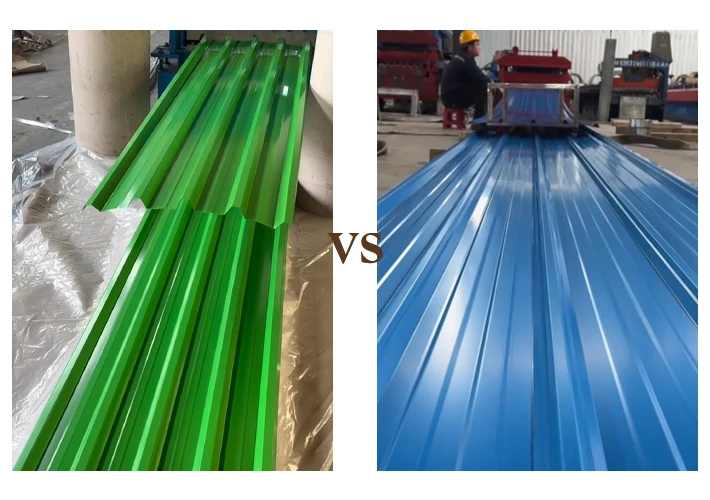
Pre-Painted Steel Roofing Sheets
Pre-painted steel sheets are manufactured from coated steel substrates with an additional paint system.
PPGI and PPGL products offer a wide range of colors and surface finishes, making them suitable for buildings where appearance is important as well as functional performance.
Potential advantages include:
- A choice of colors for architectural coordination.
- Factory-applied paint finishes.
- A consistent appearance across large roof areas.
- Options suited to different project budgets.
- Integration with matching wall cladding and accessories.
When comparing painted T-Type and IBR roofing sheets, buyers should examine the complete coating specification, including the substrate, metallic coating, paint system, and environmental suitability.
Paint systems differ in their resistance to UV exposure, fading, chalking, and corrosion. A higher-performance coating may be worth considering for buildings exposed to strong sunlight or demanding weather conditions.
Color selection should also be coordinated with the building’s architectural requirements and any applicable local regulations.
How Does Thickness Affect Roofing Performance?
Steel thickness is an important factor in roofing sheet purchasing because it affects weight, handling, stiffness, and resistance to deformation.
Thicker steel generally provides greater material strength and may improve resistance to local deformation, but thickness alone does not establish the allowable span or complete structural capacity.
The appropriate thickness depends on the roof design, purlin spacing, steel grade, profile dimensions, fixing system, and expected loads.
For example, a small agricultural shelter and a large industrial warehouse may have very different structural requirements even if both use IBR roofing sheets.
Buyers should also distinguish between base-metal thickness and total coated thickness where suppliers use different measurement conventions.
A quotation should state exactly what thickness is being offered. Otherwise, two suppliers may quote apparently similar products that do not have equivalent specifications.
For project-based purchasing, the best approach is to obtain the required thickness from the engineering design and request manufacturers to quote against that specification.
Durability in Different Climates
The right roofing system depends on the conditions in which it will operate.
In hot, sunny regions, buyers may prioritize coating durability, color stability, and thermal design.
In humid or coastal regions, corrosion protection and suitable fasteners are especially important.
In regions with strong winds, the profile, fixing arrangement, edge details, and support structure must be designed to resist wind uplift.
In areas with heavy rainfall, roof pitch, drainage channels, laps, and flashing deserve particular attention.
Neither T-Type nor IBR is universally better in every climate. The more important question is whether the selected product specification matches the building’s environmental exposure.
Applications: Which Roofing Sheet Is Better for Your Project?
Selecting between T-Type and IBR roofing sheets becomes easier when buyers start with the building’s intended use.
The following examples illustrate how different project requirements influence the decision.
Industrial Warehouses
Warehouses often require large roof areas, efficient installation, reliable drainage, and predictable material costs.
Both T-Type and IBR profiles may be suitable, provided their structural performance and installation requirements meet the building design.
For a warehouse project, procurement teams should evaluate:
- Required roof span and purlin spacing.
- Effective coverage width.
- Sheet lengths and transportation constraints.
- Coating requirements.
- Wind-load design.
- Compatible ridge, eave, and flashing accessories.
For large projects, reducing unnecessary overlaps and minimizing material waste may improve overall installation efficiency.
A wider effective coverage profile may reduce panel count, but the final choice should also consider handling, structural performance, and total installed cost.
Factories and Manufacturing Buildings
Factories may require durable roofing for production areas, storage spaces, workshops, and auxiliary facilities.
The best profile depends on the building’s structural design, exposure conditions, and operational requirements.
Where the factory is located in a humid or corrosive environment, material and coating selection becomes especially important.
Where large roof spans are required, the structural engineer should evaluate the actual profile’s load tables and support spacing rather than relying on a general statement that a particular profile is stronger.
IBR is a familiar choice for many industrial roofing applications. T-Type profiles can also be appropriate where their dimensions and engineering characteristics meet the project requirements.
Agricultural Buildings
Agricultural structures include livestock shelters, equipment storage buildings, grain storage facilities, and general-purpose farm buildings.
In these environments, the roof may be exposed to humidity, condensation, dust, animal-related emissions, and cleaning chemicals.
Buyers should consider the operating environment when specifying the steel substrate and coating system.
Condensation control may also be important, particularly where moisture can affect stored goods, equipment, or livestock.
Depending on the building design, an anti-condensation backing, insulation layer, or ventilated roofing assembly may be required. These are system-level decisions and should not be treated as automatic benefits of either profile.
Commercial Buildings
Commercial buildings may require a balance between appearance, durability, installation speed, and cost.
Pre-painted T-Type and IBR roofing sheets can be specified in different colors to coordinate with wall cladding, architectural details, and the surrounding environment.
For retail buildings, workshops, offices, and other commercial properties, buyers should evaluate both the visible roof appearance and the technical requirements of the roofing system.
Color matching and consistency between production batches can be important when large roof areas are installed in stages.
If the project requires replacement panels in the future, retaining the original profile drawing and coating specification can simplify subsequent procurement.
Residential and Prefabricated Buildings
Metal roofing is also used in residential construction, prefabricated buildings, modular structures, and temporary facilities.
The choice between T-Type and IBR should reflect the intended building design, local construction practices, aesthetic preferences, and applicable regulations.
Residential projects may place greater emphasis on visual appearance, noise control, insulation, and coordination with roof accessories.
Prefabricated buildings may benefit from customized sheet lengths that reduce cutting and simplify installation.
However, transportation length limits, lifting equipment, roof geometry, and site access must be considered before ordering long panels.
For all these applications, neither profile should be selected on the basis of appearance or price alone.
Cost Comparison: Which Option Offers Better Value?
For B2B buyers, the lowest quotation does not always represent the lowest project cost.
A meaningful comparison between T-Type and IBR roofing sheets should include material cost, installation labor, structural requirements, accessories, logistics, maintenance, and potential waste.
Material Cost
The price of a roofing sheet is influenced by several variables:
- Steel thickness and grade.
- Base material and coating system.
- Metallic coating specification.
- Paint system and color.
- Profile dimensions.
- Effective coverage width.
- Sheet length.
- Order quantity.
- Manufacturing and packaging requirements.
Because these factors can differ between quotations, buyers should avoid comparing the price per sheet without checking the actual specifications.
For example, a wider sheet may cost more per piece but cover a larger area. Conversely, a lower-priced sheet may use thinner steel or a different coating specification.
The most useful initial comparison is the material cost per square meter of effective roof coverage, followed by a full project cost calculation.
Installation Labor
Installation costs depend on the roofing layout, roof height, access conditions, sheet length, fastening system, and local labor rates.
A profile that reduces the number of panels or side laps may offer installation advantages in certain circumstances.
However, installation speed also depends on the experience of the roofing crew and the availability of compatible accessories.
The selected profile should be familiar to the installation team, or sufficient technical guidance should be available before work begins.
Structural and Support Costs
The profile’s structural characteristics can affect the required purlin spacing and supporting steelwork.
A profile with suitable stiffness may allow a different support arrangement from another profile, but this must be confirmed using the manufacturer’s technical data and the project’s engineering calculations.
Buyers should not assume that selecting IBR or T-Type automatically reduces the cost of the supporting structure.
Instead, compare complete roofing designs, including sheet specifications, purlin spacing, fixing arrangements, and structural safety requirements.
Transportation and Packaging
Transportation is an important consideration when importing roofing sheets from China.
The total shipment volume and weight depend on the quantity, profile dimensions, sheet lengths, packaging method, and container-loading arrangement.
Long sheets require careful handling and planning to reduce the risk of bending or surface damage during transportation.
For overseas projects, buyers should confirm the maximum practical sheet length, loading method, protective packaging, and destination port requirements before placing an order.
A factory quotation should clearly state whether transportation, export packaging, inland delivery, and other charges are included.
Total Cost of Ownership
The total cost of a roofing system includes more than the initial material purchase.
A practical cost assessment should consider:
- Initial material cost.
- Installation labor.
- Supporting structure requirements.
- Fasteners and accessories.
- Transportation and handling.
- Expected maintenance.
- Corrosion protection and environmental suitability.
- Replacement and repair considerations.
For example, choosing a more suitable coating system for a demanding environment may increase the initial purchase price while reducing the risk of premature deterioration.
Likewise, a profile with a competitive sheet price may not provide the best value if it requires additional support, more complex installation, or greater material waste.
For importers and wholesalers, the best purchasing decision is one that balances specification compliance, product consistency, landed cost, and customer requirements.
How to Choose the Right Roofing Sheet Supplier in China
Finding the right supplier is just as important as choosing the profile.
For importers, distributors, and construction contractors, a reliable roofing sheet manufacturer should be able to provide clear technical specifications, consistent production quality, suitable material options, and export support.
RoofGlory serves international buyers seeking steel roofing and related building materials from China. When evaluating RoofGlory or another potential supplier, buyers should focus on the following points.
Verify the Product Specifications
Ask the supplier for a technical drawing that shows the complete cross-section of the T-Type or IBR roofing sheet.
The drawing should identify the profile dimensions and effective coverage width. It should be supported by a specification sheet that states the available thicknesses, material grades, coating options, and manufacturing tolerances.
If the product is intended to replace an existing roof, provide the original drawing or a physical sample whenever possible.
This step helps prevent the common purchasing problem of receiving a profile that looks similar but cannot fit the existing roof system.
Confirm the Steel Substrate and Coating
Request a clear description of the steel substrate and coating system.
Depending on the project, this may include GI, GL, PPGI, or PPGL material, together with the specified steel grade, thickness, metallic coating, and paint system.
Where certification or inspection documents are required, confirm the applicable standards and documentation before production.
Buyers should avoid accepting vague descriptions such as “high-quality galvanized steel” when the project requires a specific coating mass or material standard.
Evaluate Production Quality Control
Consistent profile dimensions and surface quality are important for roofing installation.
A supplier’s quality-control process should address relevant manufacturing checks, such as:
- Incoming steel coil identification.
- Thickness and material verification.
- Profile dimensions.
- Effective coverage width.
- Sheet length and cutting accuracy.
- Surface coating condition.
- Packaging and finished-product inspection.
The exact inspection plan should reflect the product specification and the buyer’s quality requirements.
For large projects, buyers may arrange a pre-shipment inspection or agree on an inspection procedure before production begins.
Ask About Customization
Different markets use different roofing profiles, sheet lengths, colors, and construction standards.
A suitable supplier should explain which options are available through its existing production equipment and which require special arrangements.
Before confirming an order, ask about:
- Available T-Type and IBR profile designs.
- Minimum and maximum sheet lengths.
- Thickness and material options.
- Color selection.
- Matching ridge caps and flashing.
- Fasteners and accessories.
- Minimum order quantity.
- Production lead time.
- Packaging and shipping arrangements.
Customization should be confirmed in writing so that the final production specification matches the agreed quotation.
Compare Quotations on an Equivalent Basis
When collecting quotations from multiple Chinese manufacturers, provide the same technical specification to each supplier.
At a minimum, specify the profile drawing, material, thickness, coating, color, effective width, sheet length, quantity, packaging requirements, and destination port.
Ask suppliers to identify any deviations from the requested specification.
This makes it easier to compare actual product value rather than simply comparing headline prices.
For importers and distributors, the ability to maintain consistent specifications across repeat orders is also important. It can support more reliable inventory planning and reduce the risk of product mismatch for future customers.
Work With RoofGlory for Roofing Material Sourcing
RoofGlory is a China-based building materials supplier offering steel roofing products and related materials for international construction markets.
For buyers evaluating T-Type or IBR roofing sheets, the purchasing process should begin with the project’s technical requirements rather than a generic product name.
Share your required profile, dimensions, material, coating, quantity, and destination market with RoofGlory to help establish a suitable quotation specification.
A clear request allows the supplier to evaluate the available options and helps both parties confirm the product details before production.
For wholesale orders, distributor sourcing, and construction projects, accurate specifications and clear communication are essential to achieving reliable procurement results.
Frequently Asked Questions About T-Type and IBR Roofing Sheets
Is T-Type Roofing Sheet the Same as IBR Roofing Sheet?
Not necessarily.
T-Type is a term whose meaning can vary by supplier or market, while IBR refers to an inverted box rib profile.
Some T-Type products may have a trapezoidal geometry similar to certain IBR profiles, but this does not mean the two are universally interchangeable.
Buyers should compare the cross-sectional drawings, rib dimensions, effective coverage width, side-lap details, and fixing arrangements before making a purchasing decision.
Which Is Stronger: T-Type or IBR Roofing Sheet?
Neither profile is automatically stronger in every application.
Structural performance depends on the complete profile geometry, steel thickness, steel grade, support spacing, fixing method, and applied loads.
A properly engineered T-Type profile may be suitable for a particular project, while a specified IBR profile may be more appropriate for another.
For large-span or high-wind applications, use manufacturer technical data and engineering calculations to verify the required performance.
Which Roofing Sheet Is Better for Heavy Rainfall?
Both profiles can be suitable for rainy climates when the roofing system is designed and installed correctly.
Important factors include roof pitch, drainage channel geometry, sheet length, side laps, flashing, fasteners, and local rainfall conditions.
The buyer should verify the recommended roof pitch and installation details for the exact profile instead of relying on the product name alone.
Are T-Type and IBR Roofing Sheets Available in Different Colors?
Yes, depending on the manufacturer’s product range.
Both types may be available in pre-painted steel options, including a selection of standard or customized colors.
Color availability, paint system, and minimum order quantities should be confirmed before production. Buyers should also consider UV exposure and the required level of color retention when selecting a coating system.
Can T-Type and IBR Roofing Sheets Be Customized?
Many manufacturers can customize sheet length and offer different thicknesses, substrates, coatings, and colors.
Profile customization depends on the manufacturer’s roll-forming equipment and tooling. Not every supplier can produce every profile design.
Before ordering, confirm the drawing, dimensions, tolerances, production lead time, and minimum order quantity.
How Do I Calculate the Quantity of Roofing Sheets Required?
The initial quantity can be estimated by dividing the roof width by the effective coverage width of the selected sheet.
For example, a 12-meter-wide roof section covered by sheets with an effective width of 0.80 meters would require approximately 15 sheets across that section.
The final quantity must account for the roof geometry, slope length, overhangs, edge details, cutting requirements, and any additional material needed for installation.
For complex roofs, prepare a roof layout or ask the contractor to produce a detailed material takeoff before placing the order.
What Information Should I Provide When Requesting a Factory Quotation?
To obtain an accurate quotation from a Chinese roofing sheet manufacturer, provide:
- Product profile: T-Type or IBR, with a drawing if available.
- Steel substrate and grade.
- Required thickness.
- Metallic coating and paint specifications.
- Effective coverage width.
- Sheet length.
- Required color.
- Order quantity or total coverage area.
- Destination port and packaging requirements.
- Applicable standards and inspection requirements.
The more complete the specification, the easier it is to compare quotations and reduce misunderstandings before production.
Which Is More Cost-Effective for Importers and Wholesalers?
Cost-effectiveness depends on the full specification and the intended market.
A lower purchase price may be attractive, but buyers should also consider effective coverage width, installation labor, coating durability, transportation, material waste, and compatibility with local construction practices.
For distributors, stocking a profile that is widely used in the target market may also help simplify inventory management and after-sales support.
The best choice is the product that meets customer requirements at a competitive total cost without compromising the necessary technical performance.
Conclusion: Make the Right Choice Between T-Type and IBR Roofing Sheets
T-Type roofing sheets and IBR roofing sheets can both provide practical metal roofing solutions for industrial buildings, warehouses, agricultural facilities, commercial properties, and prefabricated structures.
Their most important differences are found in the exact profile geometry, rib dimensions, effective coverage width, side-lap design, and compatibility with the intended roofing system.
Neither profile is automatically the better option for every project. The right choice depends on structural requirements, climate, coating specification, installation conditions, local market preferences, and total project cost.
For international buyers, a reliable procurement process should include five essential steps:
- Confirm the exact profile drawing.
- Compare material, thickness, and coating specifications.
- Verify structural suitability and installation requirements.
- Calculate effective coverage and total project cost.
- Select a supplier capable of delivering consistent quality and clear export documentation.
As a China-based building materials supplier, RoofGlory supports international buyers sourcing roofing materials for wholesale distribution and construction projects.
Contact RoofGlory to discuss your T-Type or IBR roofing sheet requirements. Provide your target profile, thickness, coating, dimensions, quantity, and destination market to request a quotation tailored to your purchasing needs.
The right roofing profile is not simply the one with the lowest price. It is the one that meets the project’s technical requirements, performs reliably in its intended environment, and delivers long-term value for the buyer.