Steel is one of the most essential materials in modern industry, widely used in construction, infrastructure, manufacturing, transportation, and energy sectors. For global buyers and project decision-makers, understanding steel classifications is not just a technical issue—it directly affects cost control, structural safety, fabrication efficiency, and long-term performance.
Among all steel product categories, hot rolled steel and cold rolled steel are two of the most frequently compared, yet most misunderstood. Many buyers assume cold rolled steel is “better” simply because it looks smoother or costs more, while others underestimate the performance value of hot rolled steel in structural applications.
In reality, the difference between hot rolled and cold rolled steel lies in manufacturing process, mechanical properties, dimensional accuracy, surface finish, cost structure, and application suitability.
As a China-based steel manufacturing and export factory, we work with global B2B clients across construction, roofing, fabrication, and industrial manufacturing. This article provides a comprehensive, technical, and buyer-oriented comparison to help you make the right material decision for your project.
How Steel Rolling Works: The Core Difference Explained
Steel rolling is a metal forming process in which heated or unheated steel is passed through rollers to reduce thickness, improve uniformity, and shape the material into sheets, plates, coils, or structural profiles.
The fundamental difference between hot rolled and cold rolled steel is temperature during rolling, which directly determines:
- Grain structure
- Mechanical strength
- Surface quality
- Dimensional tolerance
- Production cost
Understanding this foundation makes all other differences much clearer.
What Is Hot Rolled Steel?
Manufacturing Process
Hot rolled steel is produced by rolling steel at temperatures above its recrystallization point, typically around 1,700°F (927°C) or higher.
The process generally includes:
Heating steel slabs or billets in a furnace
Rolling the steel while it is red-hot
Reducing thickness through multiple rolling passes
Allowing the steel to cool naturally at room temperature
Cutting or coiling the finished product
Because the steel is processed at high temperature, it can be formed easily without creating internal stress.
Key Characteristics of Hot Rolled Steel
Hot rolled steel typically exhibits the following features:
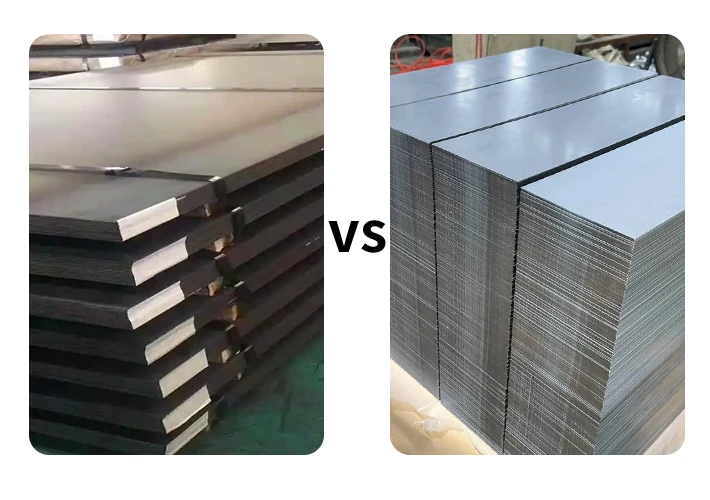
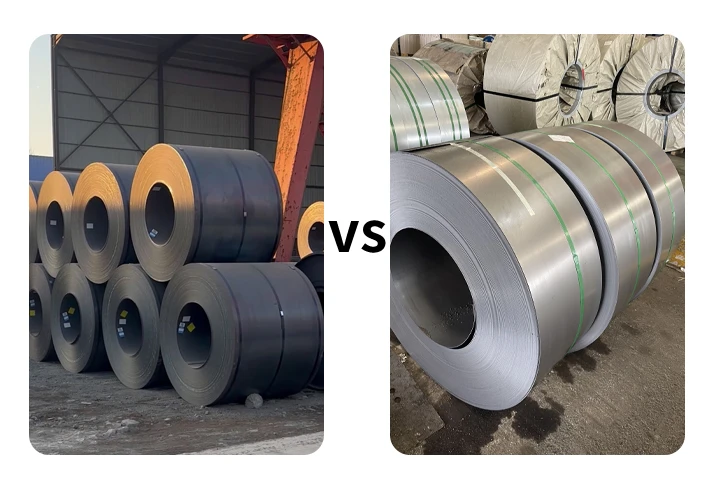
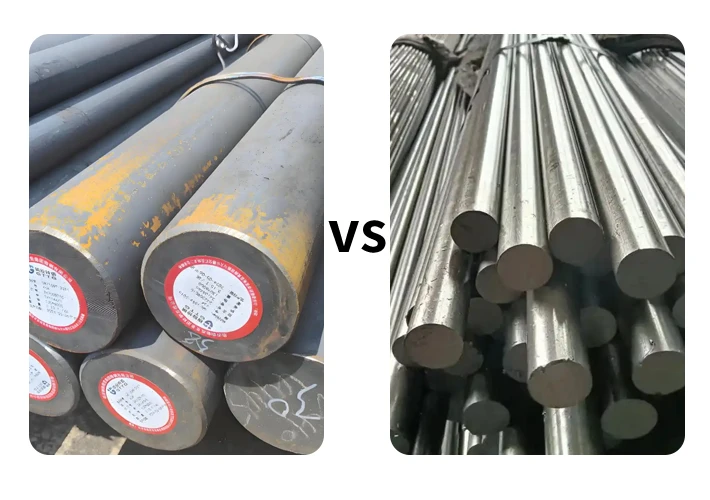
- Rough surface texture with mill scale
- Rounded edges and corners
- Looser dimensional tolerances
- Excellent ductility and formability
- Lower production and purchase cost
The cooling process is uncontrolled (air cooling), which explains why hot rolled steel is less dimensionally precise but more forgiving in fabrication.
Typical Hot Rolled Steel Products
Hot rolled steel is commonly supplied as:
- Hot rolled steel coils
- Steel plates
- H-beams, I-beams, and structural sections
- Channels and angles
- Hot rolled pipes and tubes
As a Chinese steel factory, hot rolled steel accounts for a large share of export volume due to its cost efficiency and wide application range.
What Is Cold Rolled Steel?
Manufacturing Process
Cold rolled steel is not rolled “cold” from raw material. Instead, it starts as hot rolled steel and undergoes additional processing at room temperature.
The typical cold rolling process includes:
1.Pickling hot rolled steel to remove scale
2.Rolling the steel again at ambient temperature
3.Reducing thickness with high precision
4.Annealing (optional) to reduce internal stress
5.Temper rolling to improve flatness and surface finish
This secondary processing significantly alters the steel’s structure.
Key Characteristics of Cold Rolled Steel
Cold rolled steel is known for:
- Smooth, clean surface finish
- Sharp edges and consistent thickness
- Higher tensile and yield strength
- Improved flatness and appearance
However, these benefits come with:
- Higher manufacturing cost
- Reduced ductility
- Increased internal stress
Cold rolled steel is ideal for applications where precision and aesthetics matter more than flexibility.
Typical Cold Rolled Steel Products
Cold rolled steel is widely used in:
- Automotive body panels
- Home appliances
- Office furniture
- Electrical cabinets and enclosures
- Precision steel components
In global trade, cold rolled steel is often positioned as a value-added product with stricter quality requirements.
Hot Rolled vs Cold Rolled Steel: Performance and Property Comparison
Mechanical Properties
Cold rolling increases strength through work hardening:
| Property | Hot Rolled Steel | Cold Rolled Steel |
|---|---|---|
| Tensile Strength | Lower | Higher |
| Yield Strength | Lower | Higher |
| Ductility | Higher | Lower |
| Hardness | Lower | Higher |
Hot rolled steel performs better in applications requiring bending, welding, or forming, while cold rolled steel excels in strength-critical and precision environments.
Dimensional Accuracy and Tolerances
Hot rolled steel:
- Accepts thickness variation
- Suitable for structural use
- Not ideal for precision assembly
Cold rolled steel:
- Tight thickness control
- High repeatability
- Essential for automated manufacturing
This difference is often the deciding factor for industrial buyers.
Surface Finish and Appearance
Hot rolled steel:
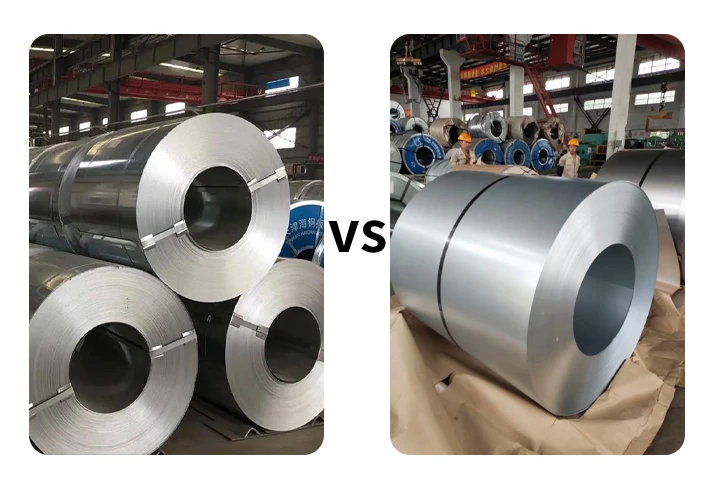
- Dark surface with scale
- Requires additional treatment for painting
- Rarely used in exposed applications
Cold rolled steel:
- Bright, smooth surface
- Ideal for painting, coating, or plating
- Common in visible components
Cost Structure and Price Differences in Global Markets
Why Hot Rolled Steel Is Cheaper
Hot rolled steel benefits from:
- Fewer processing steps
- Lower energy consumption
- Higher production efficiency
For large-volume infrastructure or construction projects, hot rolled steel offers the best cost-performance ratio.
Why Cold Rolled Steel Costs More
Cold rolled steel involves:
- Pickling and cleaning
- Secondary rolling
- Annealing and tempering
- Stricter quality control
These steps increase production cost but also create higher-value steel products.
As a China-based steel manufacturer, we see global buyers strategically combining both types to optimize total project cost.
Application Scenarios: Which Steel Should You Use?
Construction and Infrastructure
Hot rolled steel is widely used for:
- Building frameworks
- Bridges
- Warehouses
- Heavy-load structures
Cold rolled steel is used for:
- Light steel framing
- Interior structural components
- Precision connectors
Manufacturing and Fabrication
Manufacturers often choose:
- Hot rolled steel for base structures
- Cold rolled steel for panels, covers, and housings
Selecting the wrong type can lead to over-engineering or unnecessary cost increases.
Roofing, Cladding, and Building Materials
In roofing and wall systems:
- Hot rolled steel is used for structural substrates
- Cold rolled steel is preferred for formed profiles and coated sheets
This is especially relevant in PPGI, PPGL, and metal roofing production.
Hot Rolled and Cold Rolled Steel in International Trade
China is the world’s largest steel producer and exporter, supplying both hot rolled and cold rolled steel to markets in:
- Southeast Asia
- Middle East
- Africa
- Europe
- South America
For global B2B buyers, sourcing from a qualified Chinese factory offers:
- Stable production capacity
- Competitive pricing
- Custom specifications
- International standards compliance (ASTM, EN, JIS, GB)
The key is working with factories that understand export requirements, quality consistency, and application matching.
Common Buyer Misconceptions You Should Avoid
1.Cold rolled steel is not always “better”
2.Hot rolled steel is not low quality
3.Higher price does not equal higher suitability
4.Surface finish does not determine structural strength
Experienced buyers focus on performance-to-cost ratio, not appearance alone.
Conclusion: Choosing the Right Steel for Long-Term Value
The difference between hot rolled and cold rolled steel is not about superiority—it is about fitness for purpose.
Choose hot rolled steel if your project prioritizes:
- Structural strength
- Fabrication flexibility
- Cost efficiency
Choose cold rolled steel if your project requires:
- Precision
- Smooth surface finish
- Tight dimensional tolerance
As a China steel factory serving global B2B clients, we recommend evaluating steel selection based on application, processing method, and total lifecycle cost, not just material price.
Making the right choice at the material stage can significantly improve project efficiency, durability, and profitability.