Introduction
Fasteners are the unsung heroes of countless industries — from construction and furniture making to leatherwork, upholstery, and even fine art framing. Among the vast array of fasteners, tacks and nails stand out as two of the most widely used yet fundamentally different solutions for joining materials. While they may appear similar at first glance — small pieces of metal with a head and a point — their design, function, and ideal applications vary significantly.
This article provides an in-depth technical comparison of tacks and nails, focusing on their structural differences, manufacturing processes, performance characteristics, application scenarios, cost factors, and industry standards. The goal is to help industry professionals, wholesalers, and procurement specialists make informed decisions when sourcing or specifying fasteners for different projects.
Quick Answer: What Is the Difference Between Tacks and Nails?
Tacks and nails are both metal fasteners, but they are designed for different purposes. The main difference is their size, holding strength, and application.
Tacks are short fasteners with relatively large heads, mainly used for attaching thin materials such as fabric, leather, carpets, and decorative trims. They provide quick and precise fixing without damaging delicate surfaces.
Nails are longer and stronger fasteners designed for structural applications. They are commonly used in construction, roofing, flooring, fencing, and woodworking projects where higher holding strength is required.
In simple terms:
- Tacks are mainly used for decorative and light-duty fastening.
- Nails are mainly used for structural and heavy-duty fastening.
Choosing between tacks and nails depends on the material thickness, required strength, installation method, and project requirements.
Definition and Basic Differences
Before diving into details, it is essential to define the two terms clearly.
2.1 Tacks
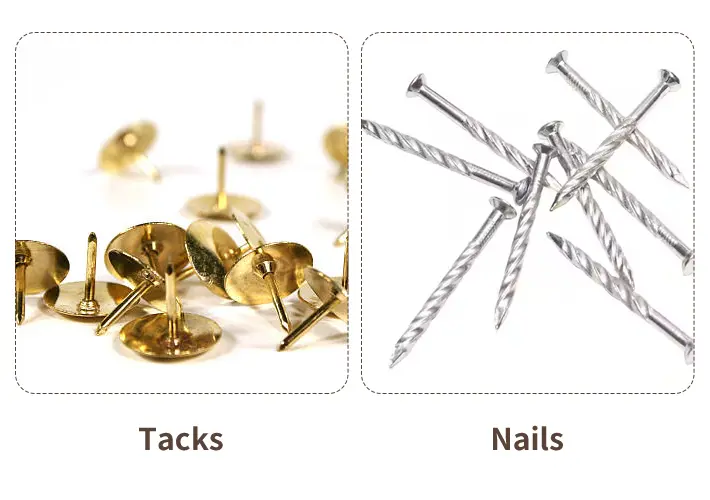
- Definition: A short, sharp-pointed fastener with a relatively large head compared to its length, used primarily for securing fabric, leather, paper, or thin wood to a surface.
- Typical Length: 5–15 mm (0.2–0.6 inches).
- Point Style: Extremely sharp for minimal penetration force.
- Materials: Steel (often brass- or copper-plated), brass, stainless steel.
- Common Uses: Upholstery, carpet laying, shoe making, leatherwork, decorative trimming.
2.2 Nails
- Definition: A long, slender metal shaft with a pointed tip at one end and a flattened head at the other, designed to fasten pieces of wood or other materials together by driving into them.
- Typical Length: 15–150 mm (0.6–6 inches) or more.
- Point Style: Designed for deeper penetration and strong holding power.
- Materials: Low-carbon steel, stainless steel, copper, aluminum.
- Common Uses: Carpentry, framing, flooring, fencing, roofing, packaging crates.
Historical Context
3.1 Tacks
- Originated in ancient Egypt for fastening leather and fabric.
- Popularized in Europe in the 18th–19th centuries for upholstery.
- Early tacks were hand-forged with irregular shapes, later evolving into machine-cut tacks.
3.2 Nails
- Archaeological evidence shows nails were used in Roman architecture and shipbuilding over 2,000 years ago.
- Industrial production began during the 18th-century Industrial Revolution with the advent of nail-making machines.
- Modern nails benefit from high-speed wire drawing technology.
Structural & Dimensional Differences
| Feature | Tacks | Nails |
|---|---|---|
| Length | 5–15 mm | 15–150+ mm |
| Shank | Short, sometimes tapered | Long, straight, various profiles |
| Head | Wide and flat for grip & aesthetics | Smaller relative to length |
| Point | Extremely sharp for surface penetration | Sharp but optimized for deeper drive |
| Strength | Lower tensile load capacity | High tensile and shear load capacity |
Observation: The structural proportions of tacks prioritize quick anchoring in thin material without splitting the substrate, while nails prioritize deep, structural holding strength.
Are Tacks Stronger Than Nails?
No, tacks are generally not stronger than nails. Nails have a longer shaft and deeper penetration ability, which provides much higher pull-out resistance and shear strength.
Tacks are designed for surface attachment rather than structural support. Their wide heads help distribute pressure and hold thin materials securely, but their short length limits their load-bearing capability.
For example:
- Upholstery fabric attached to a wooden frame → Tack is the better choice.
- Wooden framing or roof installation → Nail is the better choice.
Using the wrong fastener can reduce product durability and may cause material damage or fastening failure.
Manufacturing Processes
5.1 Tack Production
- Wire Selection: Typically thinner wire stock.
- Cutting: Wire cut to short lengths.
- Head Formation: Cold heading to create a wide head.
- Point Sharpening: Precision grinding to an extremely sharp point.
- Surface Finish: Plating (brass, copper, nickel) for corrosion resistance and aesthetics.
- Packaging: Often sold in small boxes for upholstery or decorative work.
5.2 Nail Production
- Wire Drawing: Heavy steel wire drawn to desired diameter.
- Cutting & Heading: Wire cut to length; head formed under high-pressure dies.
- Point Shaping: Chisel, diamond, or blunt points formed by cutting or grinding.
- Heat Treatment: Optional for hardened nails (concrete nails).
- Coating: Galvanizing, phosphate, or polymer coatings for corrosion protection.
- Bulk Packaging: Large quantities for industrial or construction use.
Mechanical Performance
6.1 Holding Strength
- Tacks: Lower holding strength due to short shank; ideal for thin materials.
- Nails: High pull-out resistance; suited for load-bearing applications.
6.2 Shear Strength
- Tacks: Minimal.
- Nails: Significant, especially with ring-shank or spiral designs.
6.3 Corrosion Resistance
- Both can be coated or plated; however, tacks used in decorative work often have brass or copper plating for visual appeal, while nails in outdoor use often require heavy galvanizing.
Application Scenarios
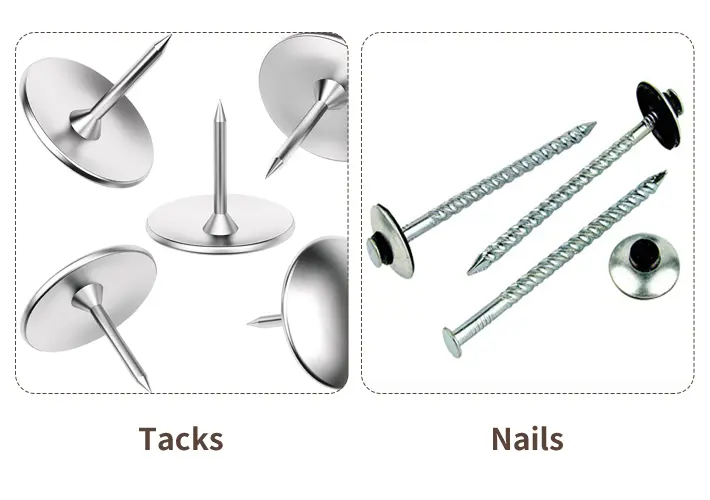
7.1 Tacks
- Upholstery (attaching fabric to wooden frames).
- Shoe making (attaching soles before stitching).
- Decorative trim in furniture.
- Securing carpets.
- Paper or poster mounting in notice boards.
7.2 Nails
- Wood framing in construction.
- Roofing and siding.
- Decking and fencing.
- Pallet and crate manufacturing.
- Flooring installation.
Can Tacks Replace Nails?
Although tacks and nails serve similar basic purposes, they cannot completely replace each other.
Tacks are suitable when appearance, precision, and minimal material damage are important. They are widely used in furniture decoration, upholstery, leather products, and crafts.
Nails are preferred when strength and long-term durability are required. Construction projects, roofing systems, wooden structures, and outdoor applications typically require nails because they can withstand higher mechanical loads.
For professional users, selecting the correct fastener improves:
- Installation efficiency
- Product durability
- Project safety
- Overall cost performance
Cost Considerations
| Factor | Tacks | Nails |
|---|---|---|
| Material Usage | Less metal per piece | More metal per piece |
| Production Cost | Lower (small, less material) | Higher per unit but cheaper per kg |
| Market Price | Higher per kg (due to small size & packaging) | Lower per kg in bulk |
Example (2025 market reference, FOB China):
- Tacks: $2.5–$4.5 per 1,000 pcs (brass-plated steel).
- Nails: $800–$1,200 per metric ton for common steel nails.
Industry Standards & Specifications
Tacks
- BS 3382 (UK upholstery tacks standard).
- ASTM F1667 (covers various driven fasteners, including tacks).
Nails
- ASTM F1667 (nails, spikes, staples).
- ISO nails standards: ISO 898 for mechanical properties.
- JIS A 5508 for construction nails in Japan.
Buying Guide for Importers and Wholesale Buyers
For importers, distributors, and construction material buyers, selecting the right fastener supplier is as important as selecting the right product.
Before purchasing tacks or nails in bulk, buyers should consider the following factors:
1. Material and Surface Treatment
Different applications require different materials and coatings:
- Galvanized steel nails for outdoor and construction applications
- Stainless steel fasteners for corrosion-resistant environments
- Brass or copper plated tacks for decorative furniture applications
2. Size and Specification Options
Professional suppliers should provide:
- Customized lengths and diameters
- Different head designs
- Various point types
- OEM packaging options
3. Manufacturing Capability
Reliable fastener manufacturers should have:
- Stable raw material supply
- Automatic production equipment
- Quality inspection procedures
- Export packaging experience
For wholesalers and distributors, working with an experienced manufacturer helps ensure consistent quality, competitive pricing, and reliable delivery.
Advantages & Disadvantages
Tacks
Advantages:
- Excellent for delicate or thin materials.
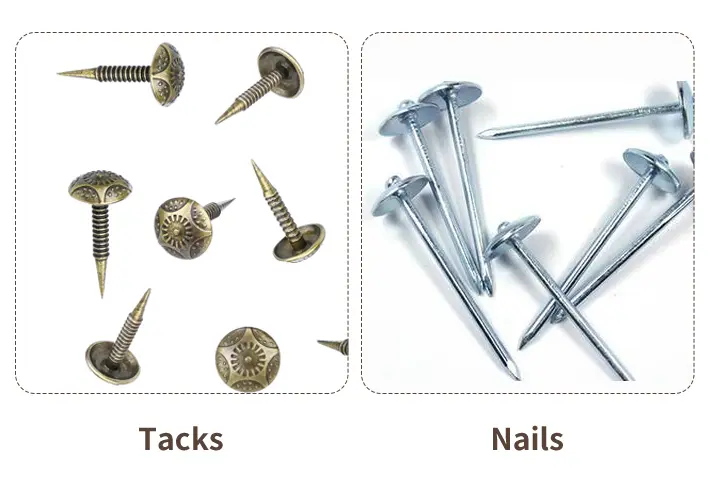
- Decorative finishes available.
- Easy manual application.
Disadvantages:
- Low structural strength.
- Not suitable for heavy loads.
Nails
Advantages:
- Strong, durable fastening.
- Wide range of sizes & types.
- Suitable for structural applications.
Disadvantages:
- Can split thin materials.
- Requires more force or tools to drive.
Selection Guide for Professionals
| Requirement | Recommended Fastener |
|---|---|
| Upholstery work | Tack |
| Attaching roofing sheets | Nail (roofing type) |
| Decorative leather trim | Brass-plated tack |
| Heavy structural framing | Common nail |
| Outdoor fencing | Galvanized nail |
Frequently Asked Questions About Tacks and Nails
Are tacks and nails the same?
No. Although both are fasteners, tacks are mainly used for decorative and light-duty applications, while nails are designed for stronger structural fastening.
Which is better for furniture, tacks or nails?
It depends on the furniture application. Tacks are commonly used for upholstery fabrics and decorative elements, while nails may be used for wooden frame construction.
Which fastener is better for roofing projects?
Nails are the preferred choice for roofing because they provide stronger holding power. Roofing nails with galvanized or corrosion-resistant coatings are commonly used for long-term outdoor performance.
Are nails cheaper than tacks?
In bulk industrial purchasing, nails are usually more cost-effective by weight. Tacks may have a higher unit price because of their smaller size, special finishes, and decorative applications.
Conclusion
While tacks and nails both serve as fasteners, they occupy very different niches in the manufacturing and construction landscape. Tacks excel in precision, decorative, and light-duty applications, while nails dominate structural and heavy-duty fastening tasks.
For B2B procurement, understanding these distinctions is crucial. Wholesalers and contractors who specify the right fastener for the right job can ensure durability, aesthetics, and cost efficiency in their projects.
Looking for a Reliable Tack and Nail Supplier?
For wholesalers, distributors, and industrial buyers, choosing a reliable fastener manufacturer ensures stable quality and competitive supply.
We provide customized tack and nail solutions for different industries, including furniture, construction, roofing, packaging, and hardware distribution.
Contact us for bulk orders, OEM packaging, customized specifications, and factory-direct pricing.